
Last updated September 20, 2026
Full 25-point door and opener safety check with every visit - springs, cables, rollers, tracks, and your LiftMaster or Chamberlain opener included
You get a price before we start. It does not change when the truck arrives.
 Before
 After
After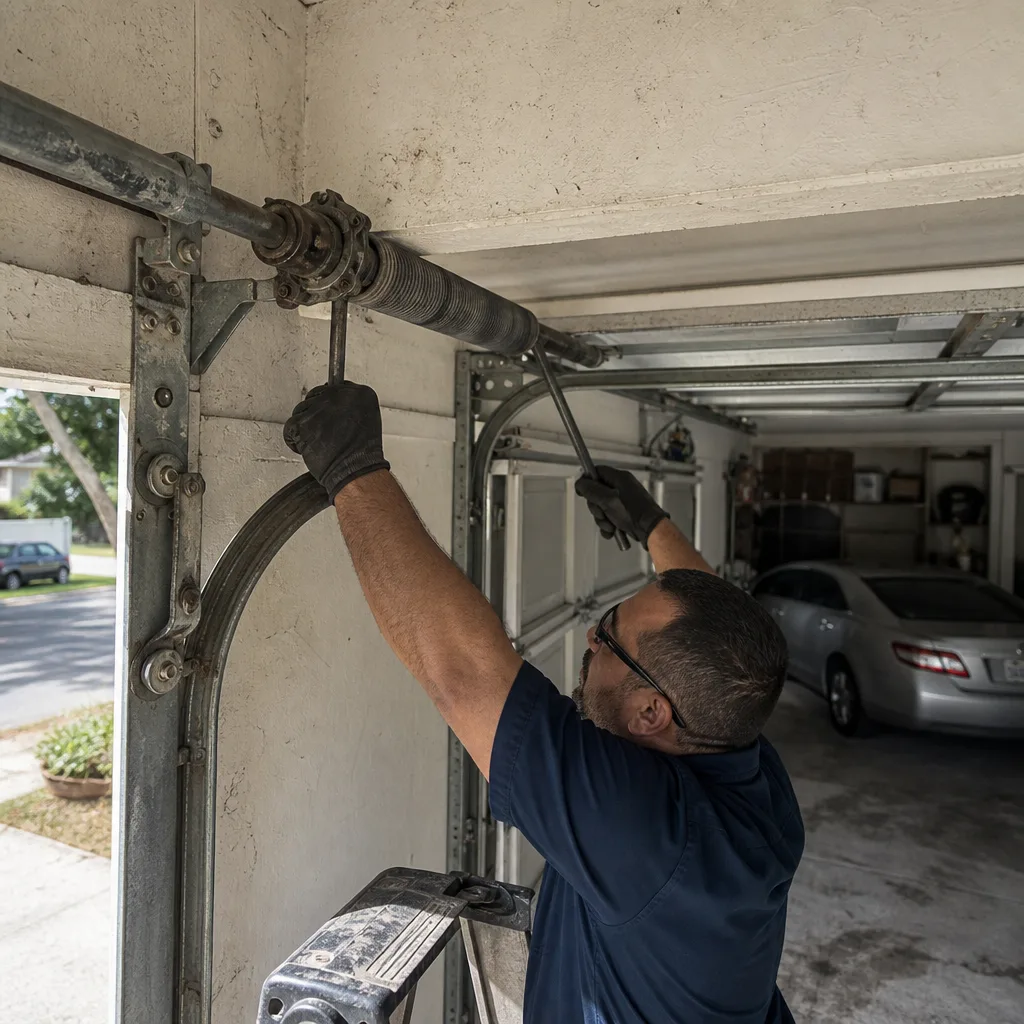 Before
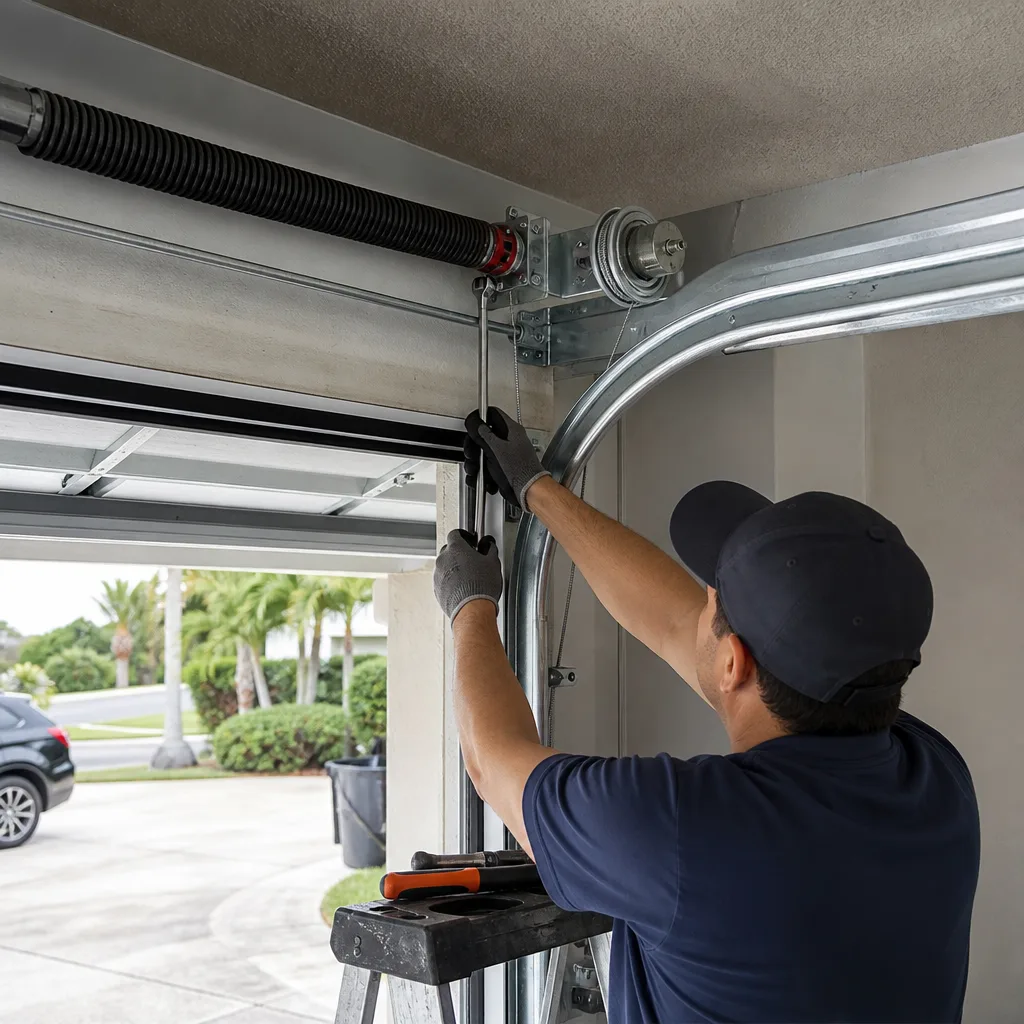 After
After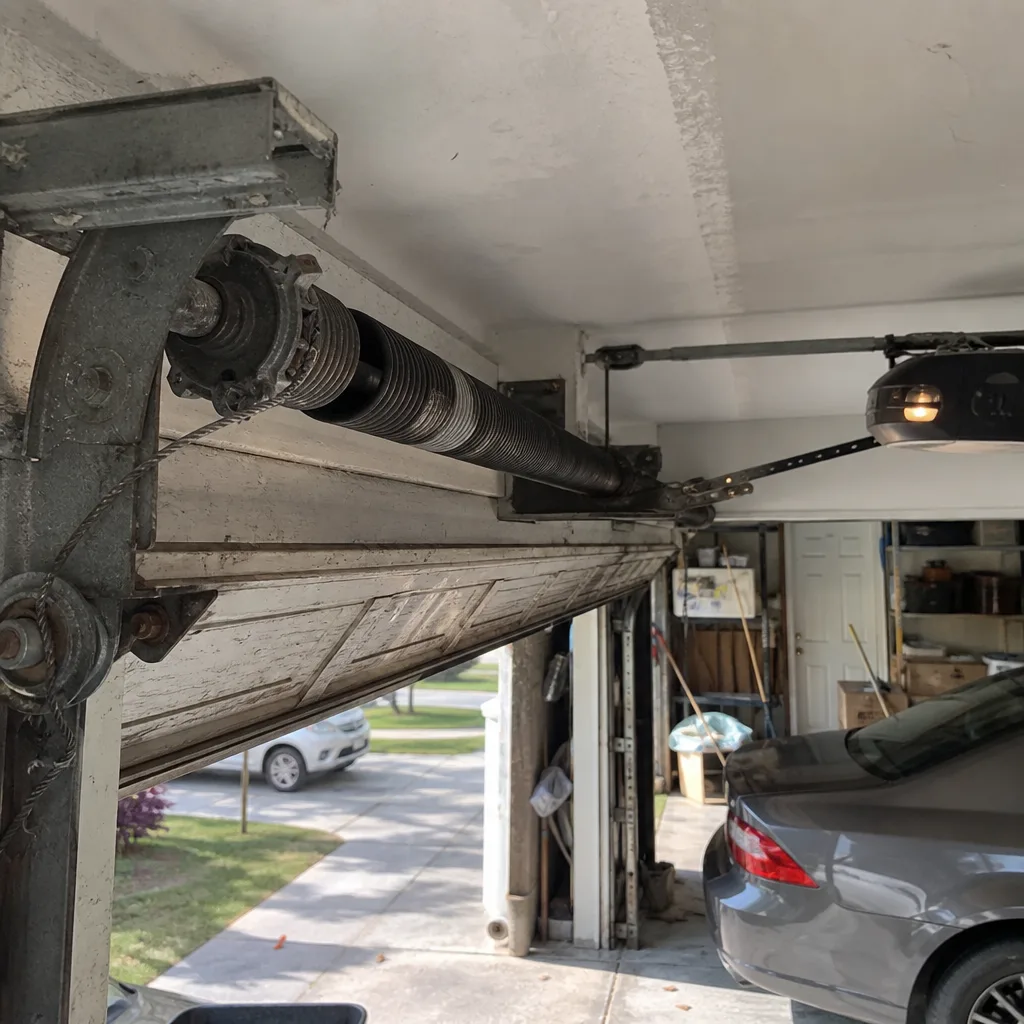 Before
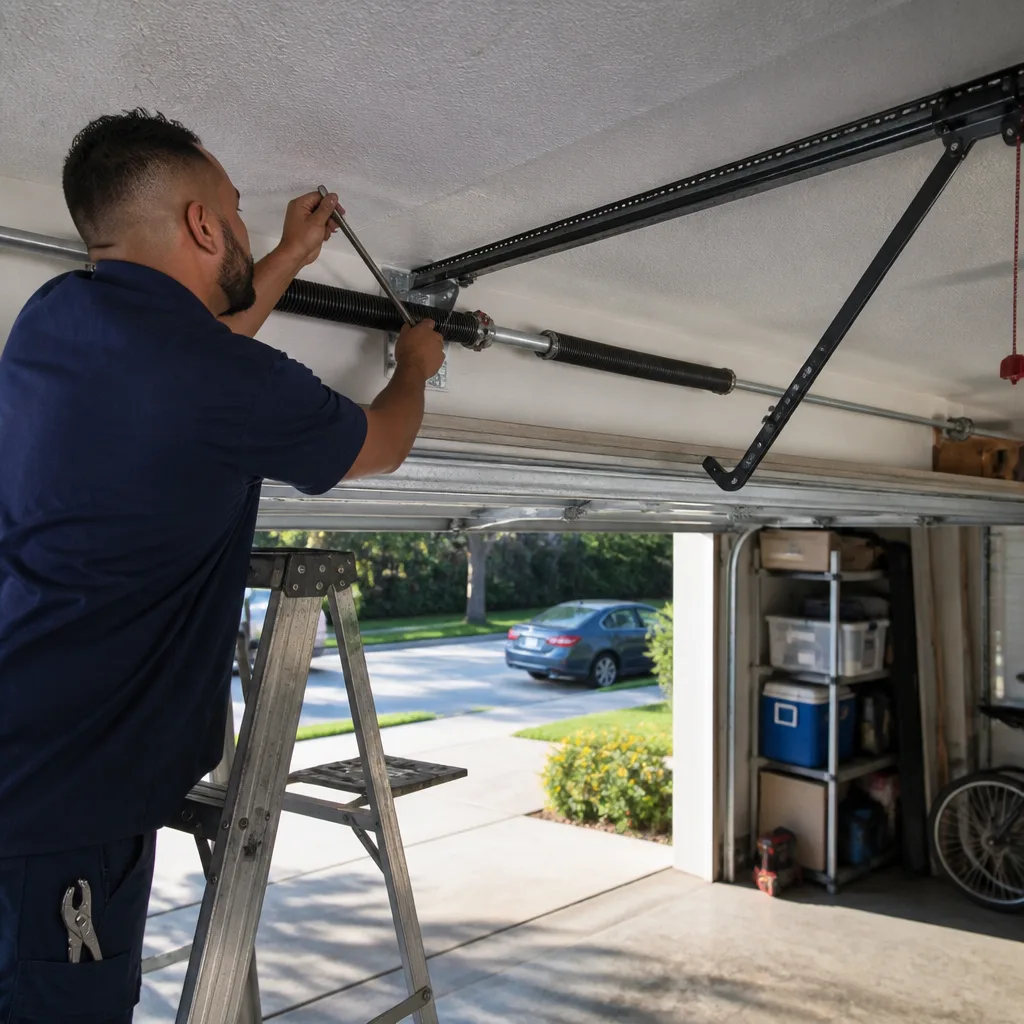 After
AfterGarage Door Repair Maintenance Checklist for West Palm Beach Homeowners
Torsion springs in West Palm Beach fail at roughly twice the national average cycle rate. The reason is not salt air or hurricanes. It is the daily thermal swing: a door surface that measures 140°F by noon drops 50 degrees or more after an evening thunderstorm, and that repeated expansion and contraction fatigues the coil steel faster than any manufacturer’s published cycle rating accounts for. This guide replaces the generic calendar checklist with a condition-based one, built around the specific failure modes our climate actually produces. You will learn what to inspect, what measurements mean replacement is overdue, and what you can safely ignore.
Quick Answer
A garage door maintenance checklist for West Palm Beach should prioritize six items: torsion spring balance testing, bottom bracket and hinge corrosion inspection after wet season, track hardware and fastener audits before hurricane season, lubrication with heat-stable products only, photo documentation of every component before and after service, and door balance re-checks every four months, not annually. The most important single habit is photographing components while they still work, because that creates the only reliable baseline for future repair decisions. Most failures we see in West Palm Beach are predictable months before they happen.
Table of Contents
- Why Calendar Checklists Fail in West Palm Beach
- The Four-Minute Torsion Spring Balance Test
- Corrosion Inspection: What to Check After Wet Season
- The Pre-Hurricane Season Hardware Audit
- Lubrication in Florida Heat: What Degrades and What to Use
- Photo Documentation as a Maintenance Record
- Common Mistakes to Avoid
- When to Call a Professional
- Frequently Asked Questions
BeforeAfterWhy Calendar Checklists Fail in West Palm Beach
Most garage door maintenance guides are written for a national audience and organized around time: lubricate every six months, inspect cables annually, replace weatherstripping every two years. In West Palm Beach, that model breaks down quickly. A hinge that looks fine in February may show measurable corrosion by August, simply because the wet season delivers afternoon humidity above 80 percent for 90 consecutive days. A torsion spring rated for 10,000 cycles may fail at 5,500 because the steel spent the summer cycling through daily temperature swings the manufacturer never tested for.
The better model is condition-based. You inspect a component when the conditions that degrade it have occurred, not when a calendar says to. After the first month of wet season, you check bottom brackets and hinges. After any wind event above 50 mph, you check fasteners and struts. After a week where daytime highs stayed above 90°F every day, you run the spring balance test. This is how we approach garage door repair in West Palm Beach, and it is also how homeowners should approach prevention.
What follows is the inspection sequence we would use on any door in West Palm Beach, arranged by the failure mode each check is designed to catch. None of these checks require special tools. Most take under ten minutes.
The Four-Minute Torsion Spring Balance Test
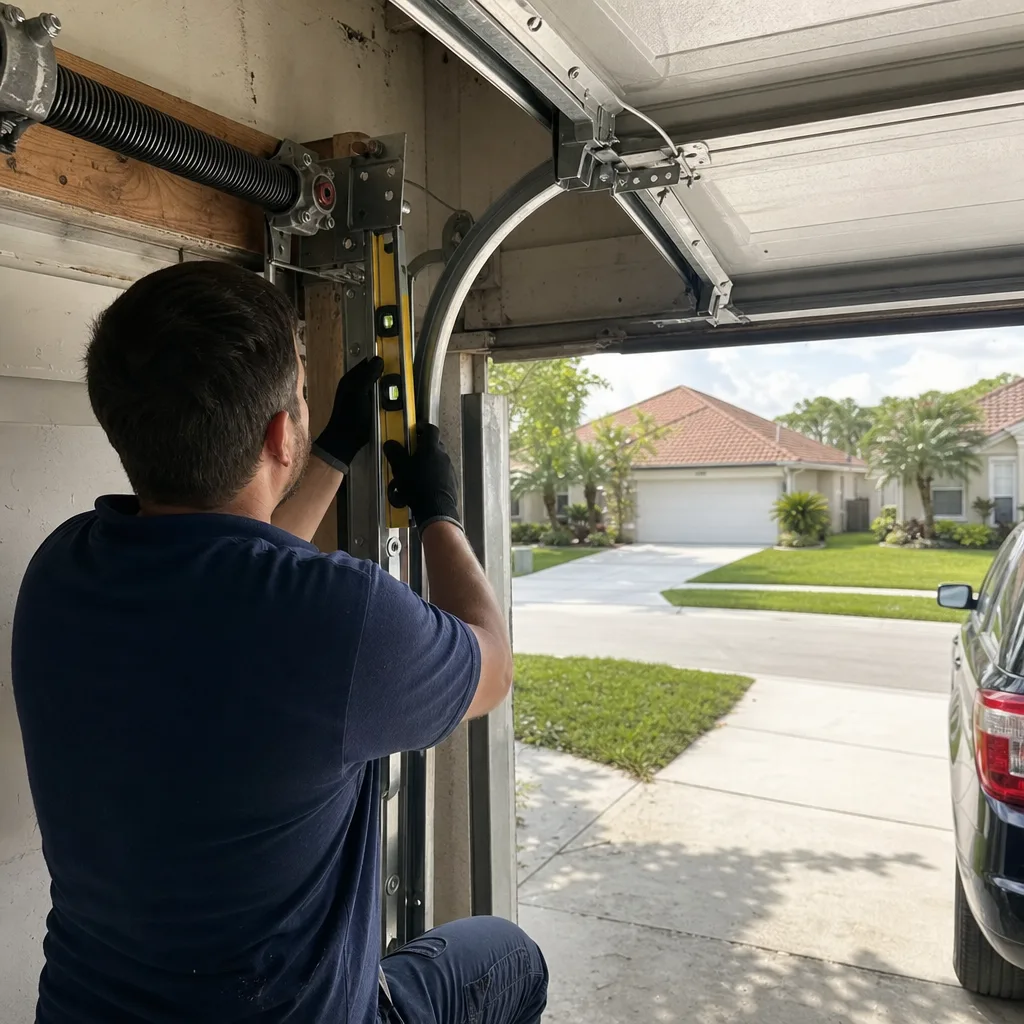
A torsion spring does not typically snap without warning. It loses tension gradually over weeks or months, and the door tells you. The test is simple, takes four minutes, and should be done every three to four months in West Palm Beach because our heat accelerates the fatigue cycle. Here is the step-by-step:
- Close the garage door completely.
- Pull the red emergency release handle. This disconnects the door from the opener carriage so you are testing the spring alone, not the motor.
- Lift the door manually to waist height, roughly three feet off the ground.
- Let go. Do not guide it. Do not hold it.
What happens next tells you the spring’s condition. A properly tensioned spring holds the door in place at waist height. It stays put, or drifts down an inch or two. If the door drops to the floor, the spring has lost tension and is working harder than it should on every cycle. If the door shoots upward, the spring is over-tensioned, which is equally dangerous. If the door is heavy to lift at all, the spring is doing very little of the work it is supposed to do, and the opener motor is absorbing the difference.
None of these results mean the spring will snap tomorrow. What they mean is that you have a measurable baseline. Re-run the test monthly. If the door drops faster each month, the spring is declining and you should plan for replacement. In our experience with garage door opener repair and installation in West Palm Beach, doors with deteriorating springs also shorten opener life, because the motor carries load it was never designed to carry. The spring is a wear component, and in West Palm Beach it wears faster than the national average. Test it more often than the manual suggests.
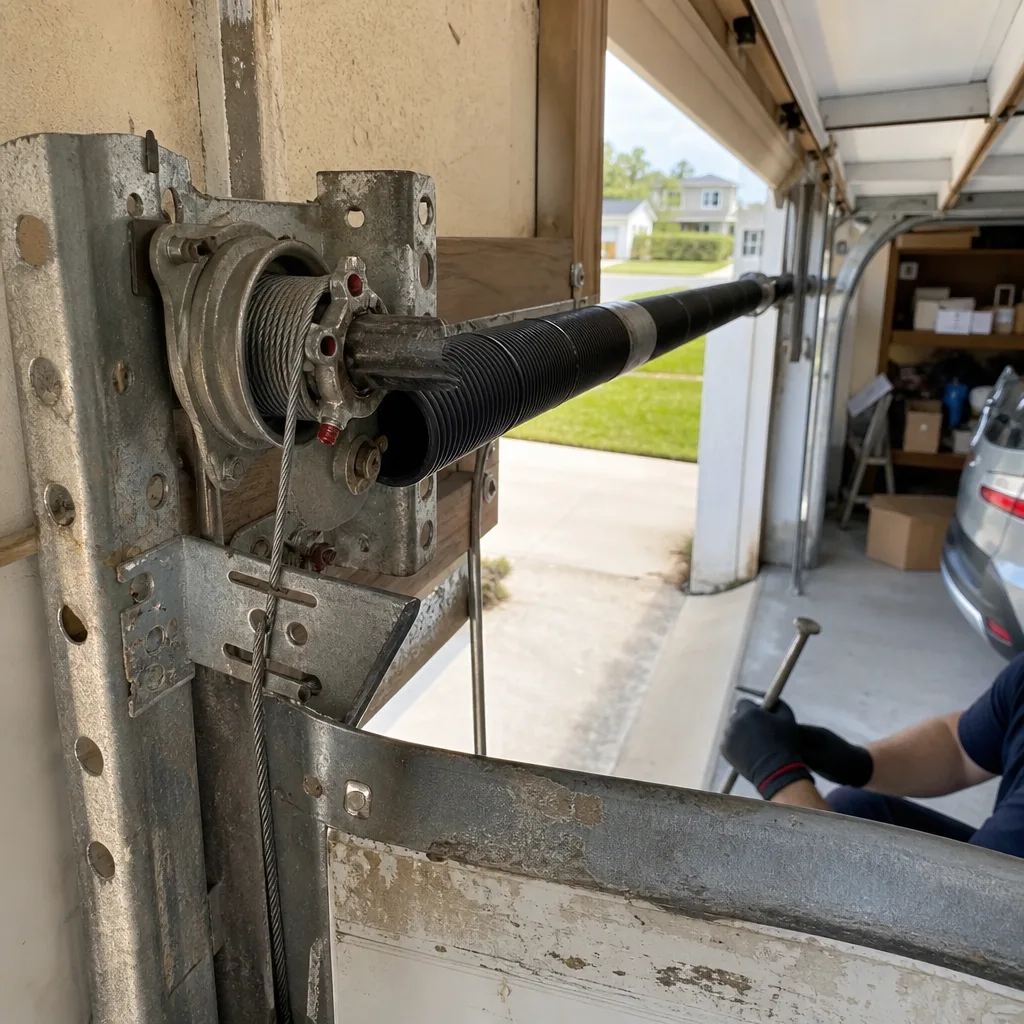
One safety note that does not make it into most checklists: if you hear a loud bang from the garage and find the door will not open, that is a snapped torsion spring. Do not attempt to open the door manually and do not disconnect the opener. A snapped spring leaves zero tension on the lifting cables, and a door with no spring tension can drop without warning. Call a professional for Garage Door Repair services. The spring is under extreme tension even when intact, and attempting to adjust or replace it without the correct winding bars is a serious injury risk. Leave spring replacement to someone who does it daily.
Corrosion Inspection: What to Check After Wet Season
West Palm Beach’s wet season runs May through October, and it is the most corrosive thing your door hardware faces all year. Not the rain itself; the pattern. Morning sun heats the metal, afternoon thunderstorms drench it, and evening humidity keeps it wet overnight. That cycle repeats for six months. The result is corrosion concentrated at specific points, and knowing which points matters more than a general visual sweep.
Here is where to look, and what the measurements mean:
- Bottom brackets: These hold the lifting cables at the bottom corners of the door. They sit closest to ground splash and puddle water. Surface rust is normal after two or three wet seasons. What is not normal is rust flaking, pitting deeper than the paint layer, or visible thinning at the cable slot. If the cable slot is rusted wide enough to let the cable slop around, the bracket is overdue for replacement. If surface rust is caught before pitting, a wire brush and a rust-converting primer buys years.
- Hinges: The hinge between the bottom two panels sees the most water exposure. Test each hinge by wiggling the panel. Lateral movement of more than an eighth of an inch means the hinge pin or the hinge leaf itself is worn. Lubrication can quiet a squeaking hinge, but it cannot restore metal that has already worn away.
- Track hardware: The vertical tracks run close to the floor and catch splash from the driveway. Check the track bolts where they mount to the wall. A bolt whose head is rusted so badly that a socket no longer seats cleanly is a bolt you cannot safely tighten or remove. That is the replacement threshold, not before.
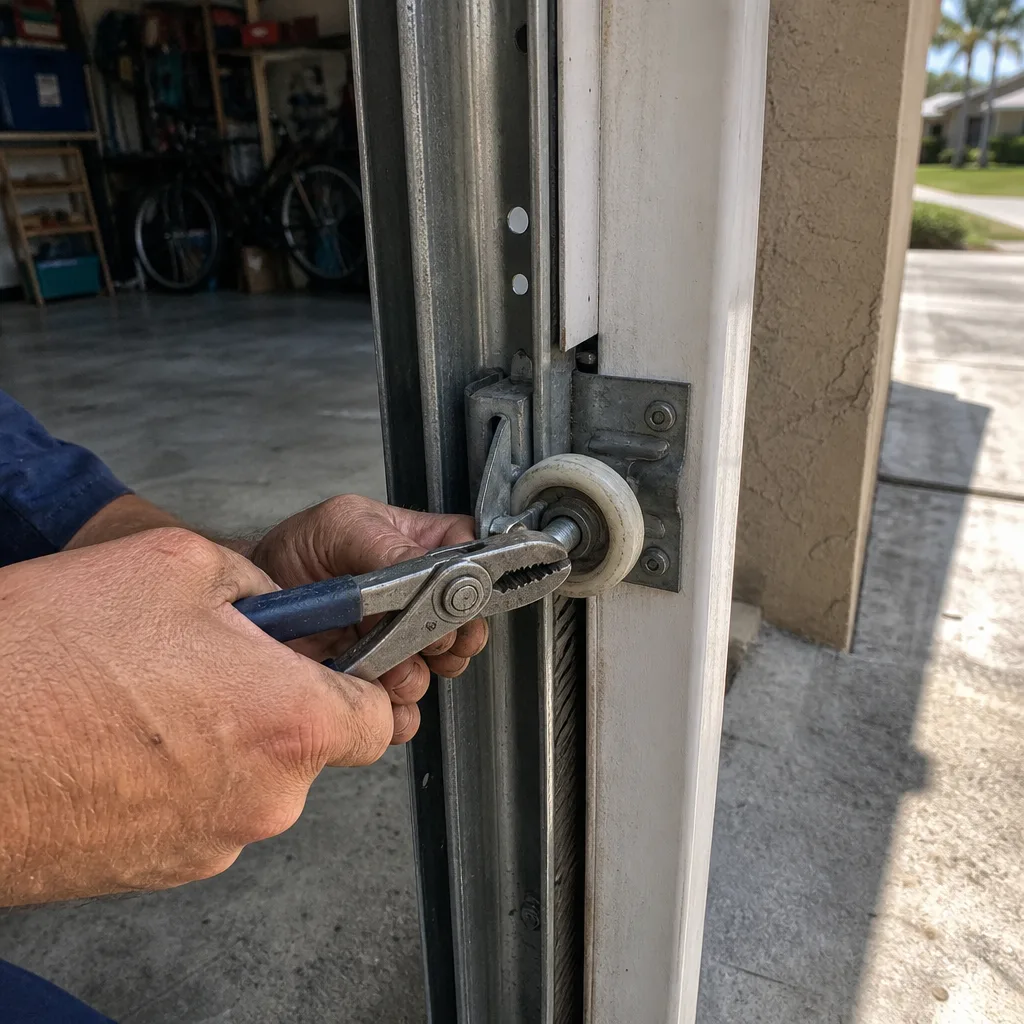
- Rollers: Nylon rollers with sealed bearings survive West Palm Beach humidity far better than steel rollers with exposed ball bearings. If your door has steel rollers, check for flat spots and rough rolling by running the door and listening. A roller that rumbles instead of rolling is a roller putting side load on the track.
The distinction that saves money is between corrosion that is cosmetic and corrosion that is structural. Surface rust, even heavy surface rust, is addressable with a wire brush and proper coating. Pitting, thinning, and flaking are not. If you can see the bracket has lost material, if the metal is visibly thinner at the stress point, you are past lubrication and into replacement. The part has already failed structurally, even if it has not broken yet.
The Pre-Hurricane Season Hardware Audit
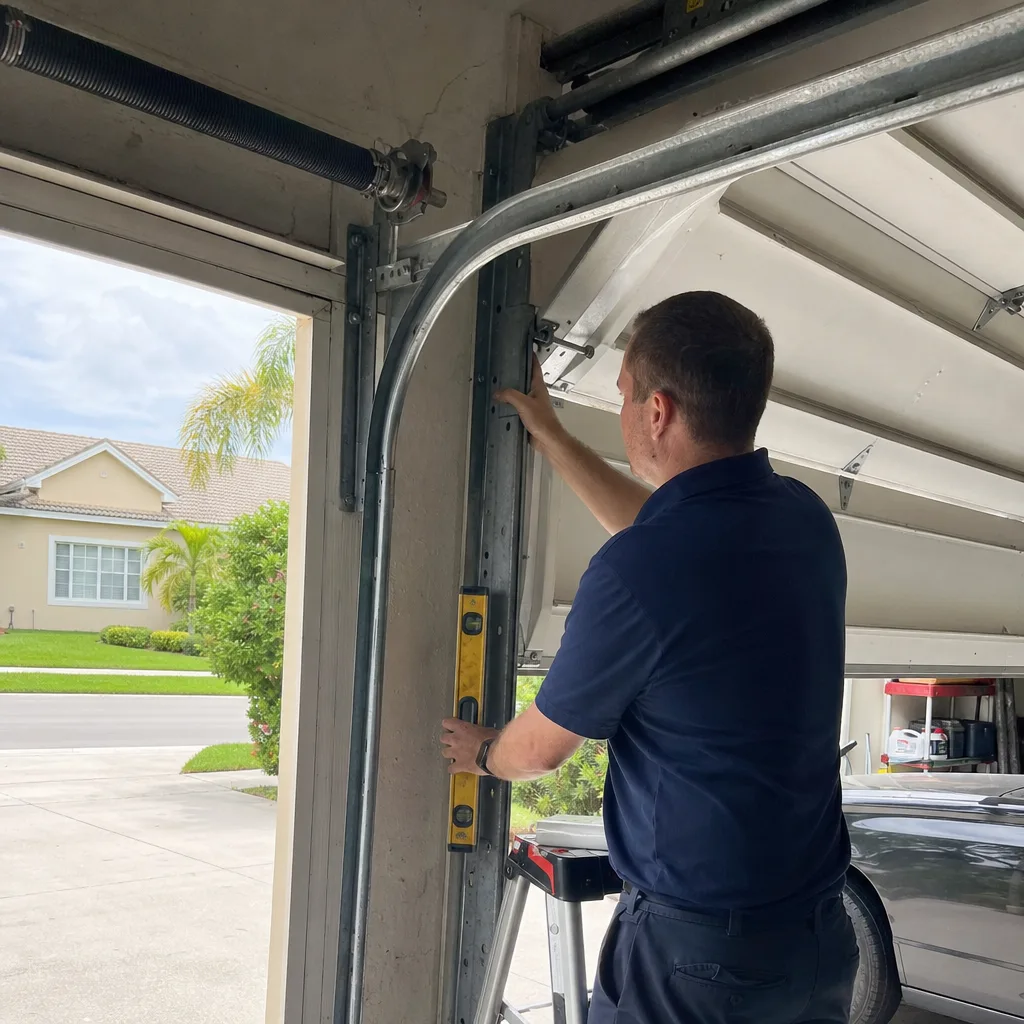
Hurricane season in South Florida begins June 1, but the hardware audit should happen in April, before the season’s first storm threat. A wind-rated garage door is only as strong as the hardware that attaches it to the building and the struts that keep its panels from flexing. If the fasteners have corroded or worked loose, the wind rating printed on the door is a number, not a fact.
Run this audit in order:
- Check every track bolt. The vertical and horizontal tracks are bolted to the wall and ceiling with lag screws or track bolts. In West Palm Beach, these rust from the head down. If a bolt head shows heavy rust, tap it with a wrench. A bolt that has lost its bite will spin or feel soft. That is a bolt that will not hold the track in a 90 mph gust.
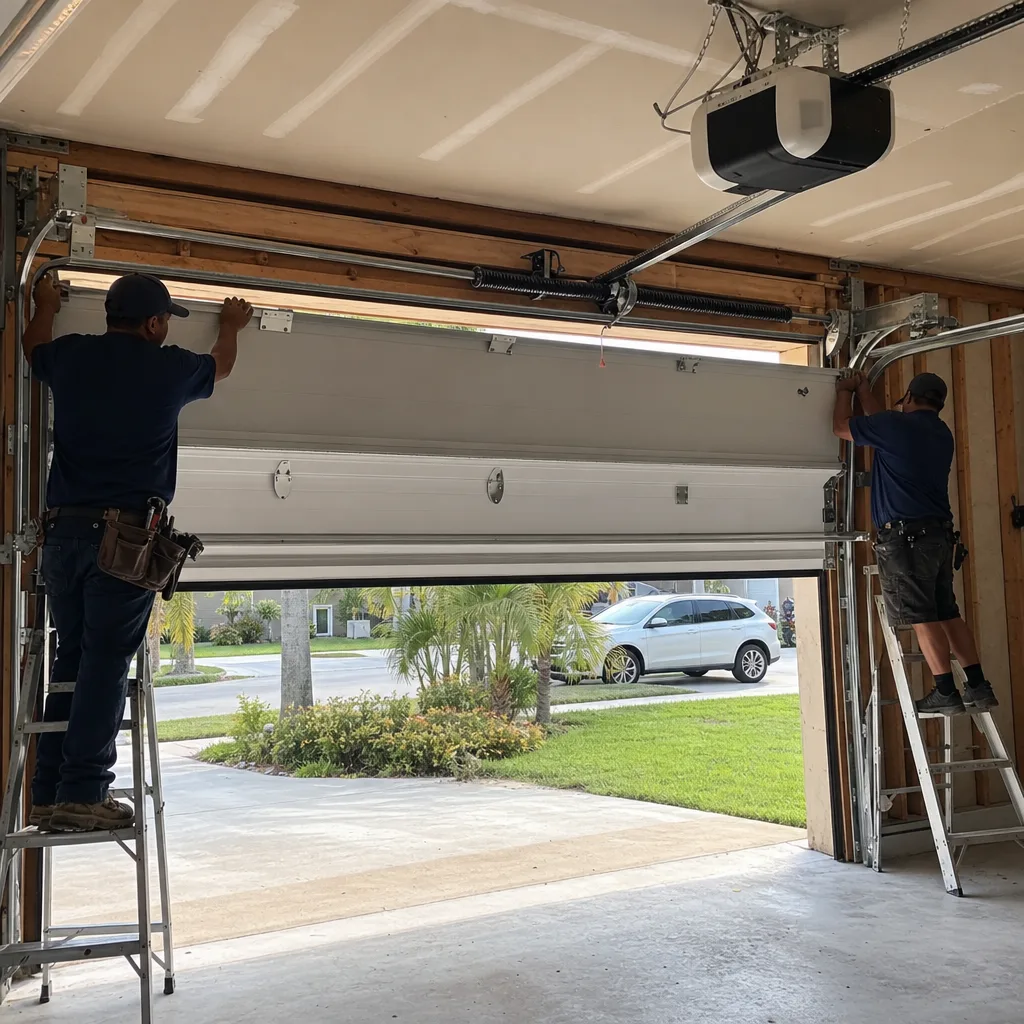
- Inspect the struts. Struts are the long metal reinforcements across the back of each door panel, and they are the difference between a door that holds its shape in a storm and one that folds inward. Check the strut-to-panel fasteners at each end and in the center. Any missing fastener reduces the panel’s stiffness. Any strut that is dented or bowed has already done its job once and will not do it as well again.
- Check the jamb brackets. These mount the vertical track to the door framing at the wall. They take the full wind load before the track bolts do. Look for gaps between the bracket and the wall, elongated bolt holes, or brackets that have pulled away from the jamb. If you can slide a putty knife behind the bracket, the bracket is no longer seated against the wall and the load path is broken.
- Test the door by hand. Pull the release and run the door up and down manually. It should move smoothly with no binding. A door that binds during manual operation will bind worse under wind load, and the opener will fight it every day until something gives.
If your home is in an older West Palm Beach neighborhood like Flamingo Park or Grandview Heights, where some garage doors date to the 1980s and 1990s, pay particular attention to the fasteners. Pre-2000 installations often used uncoated steel hardware, and 25-plus years of South Florida storm cycles takes a measurable toll on it. A door installed before the 2001 Florida Building Code changes may also lack the strut count that current wind-load standards assume. The door may have been fine when it was installed. That was a different climate, and a different code.
Lubrication in Florida Heat: What Degrades and What to Use
The most common lubrication mistake we see in West Palm Beach is using white lithium spray grease. In a dry climate, lithium grease is a decent general-purpose lubricant for garage door hardware. In our climate, it is a problem. Applied in July, white lithium spray is often gummy by September. The carrier solvent evaporates fast in 90°F heat, and the remaining lithium soap thickens into a sticky paste that attracts sand, dust, and salt particles. The result is hardware that feels lubricated for a few weeks and then moves worse than before.
Here is what to use instead, by component:
- Torsion spring coils: Spray the spring directly with a silicone-based lubricant. The goal is to coat the coils so they slide against each other as the spring winds and unwinds. Silicone stays stable through the temperature range West Palm Beach sees, and it does not attract grit the way petroleum products do.
- Hinges and rollers: Use a spray lubricant with Teflon or PTFE. Apply it at each hinge pin and at the roller bearing, then run the door twice to work it in. If you have nylon rollers, lubricate the bearing, not the wheel against the track. The nylon wheel is designed to run dry.
- Track: Do not lubricate the track. This surprises homeowners, but the track is not a wear surface. The rollers ride on it, and lubricant on the track just builds up a sticky film that collects sand. If the door is noisy and the track is clean, the problem is the roller, the hinge, or the spring, not a dry track.
- Opener rail: If you have a chain-drive or belt-drive opener from LiftMaster, Chamberlain, or Genie, the rail needs some attention. A small amount of white lithium on the chain or a silicone spray on the screw drive is adequate. Skip the door hinges and springs with the lithium; the chemicals that make it good for a chain are the same ones that gum up a spring in July.
Frequency matters more than product choice. In West Palm Beach, lubricate hinges, rollers, and springs every three months. The heat breaks down lubricant film faster here than in most of the country, and the wet season washes residue off the bottom hardware. A three-month interval is the baseline; if you live near the Intracoastal or within a mile of the ocean, make it every two months. Salt air is relentless on exposed metal, and even stainless hardware used in coastal West Palm Beach installations shows more wear than identical hardware installed ten miles inland.
Photo Documentation as a Maintenance Record
Photographing your garage door components on a schedule is the single most useful maintenance habit we can recommend, and almost no homeowner does it before a failure occurs. For Garage Door Warning Signs: A West Palm Beach Homeowner’s Reference Guide, photos are essential documentation. Here is the problem with relying on memory: when a torsion spring snaps or a bottom bracket rusts through, you are suddenly trying to remember what that component looked like six months ago. Was the rust already there? Was the spring sagging? Was the cable fraying at the drum? You cannot answer those questions from memory, and without a photo, neither can anyone else.
The solution is a photo record. Once every four months, take six pictures with your phone:
- The torsion spring, from each side, showing the coil condition.
- The bottom bracket on each side, close enough to see the cable slot and the bolt heads.
- The cable drum on each side, showing how the cable wraps.
- Each hinge, starting with the bottom panel hinge.
- The track bolts on both sides, at floor level where corrosion starts first.
- The door panels themselves, both inside and outside, in case a crack or dent appears later.
Then store them in a dedicated album on your phone with the date. That is the entire system. It takes five minutes a season, and it gives you something no inspector, no technician, and no memory can provide: a dated baseline.
This is the same logic behind the photo record we deliver on every service visit. Clause 4 of The Haven Standard, the standard Servo operates under, requires the technician to photograph the failed component before quoting a replacement. The customer sees the broken spring, the rusted bracket, the frayed cable with their own eyes, not the technician’s word for it. When you start keeping your own photo record, you extend that same evidence-first approach to the months between service visits. You will know what changed and when it changed, and the record will make any future repair discussion faster and more honest.
In our experience, homeowners who keep a photo record also catch problems earlier, because the act of photographing forces them to look. The bottom bracket that looks fine from six feet away shows pitting at the cable slot when you zoom in on it. The cable that looks smooth shows a broken strand when you photograph it in direct sunlight. Most garage door failures in West Palm Beach announce themselves weeks in advance. The photo record is how you hear the announcement.
Common Mistakes to Avoid
- Lubricating the track. The track is not a wear surface, and lubricant on it collects sand and grit from the driveway. Keep it clean, not greased.
- Using WD-40 as lubricant. WD-40 is a water displacer and solvent, not a long-term lubricant. It will clean a hinge and then leave it with less protection than it started with. Use silicone or Teflon spray instead.
- Ignoring a door that is getting louder. A garage door that was quiet and now rattles or grinds is telling you something has changed. The change is usually a failing roller, a hinge that is starting to bind, or a spring that is wearing unevenly. All three are cheaper to address before the part fails completely.
- Waiting for a snapped spring to plan for spring replacement. The balance test described above tells you months in advance that a spring is weakening. If the door drops when released at waist height, start planning the replacement. A spring that fails under load can damage cables, panels, and the opener.
- Replacing only one spring. Torsion springs on a two-spring door wear at nearly the same rate because they cycle together. Replacing one means the other is close behind. Replace both, and you reset the door to a matched pair instead of creating another failure waiting to happen.
- Skipping the hurricane hardware audit because the door “feels fine.” The fasteners that fail in a storm do not usually show symptoms during normal operation. They fail when wind load exceeds their remaining strength. The audit is the only way to know.
- Using a calendar from a northern state. A maintenance schedule written for Michigan or Ohio assumes winter damage and dry summer air. West Palm Beach reverses that: our wet season is the corrosive season, and our summer heat is the spring fatigue season. The conditions are different, so the schedule should be too.
When to Call a Professional
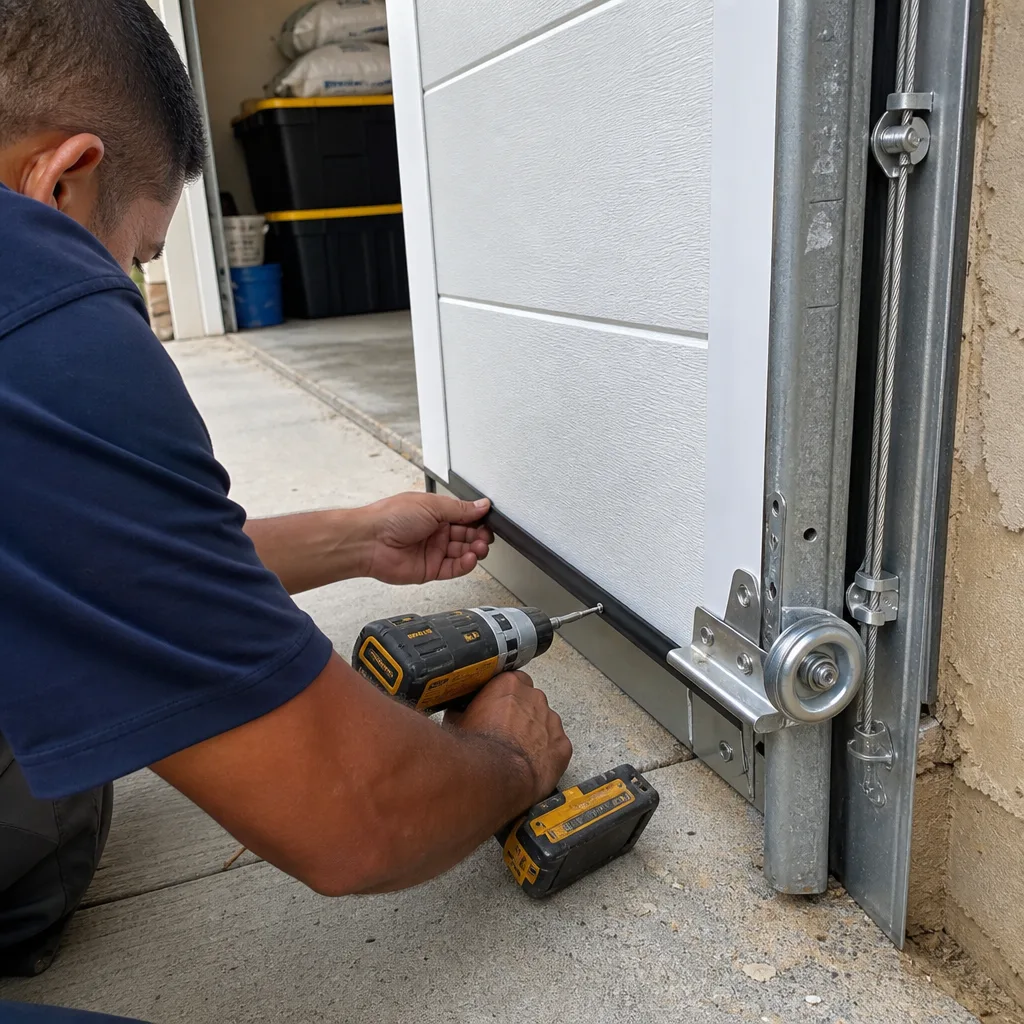
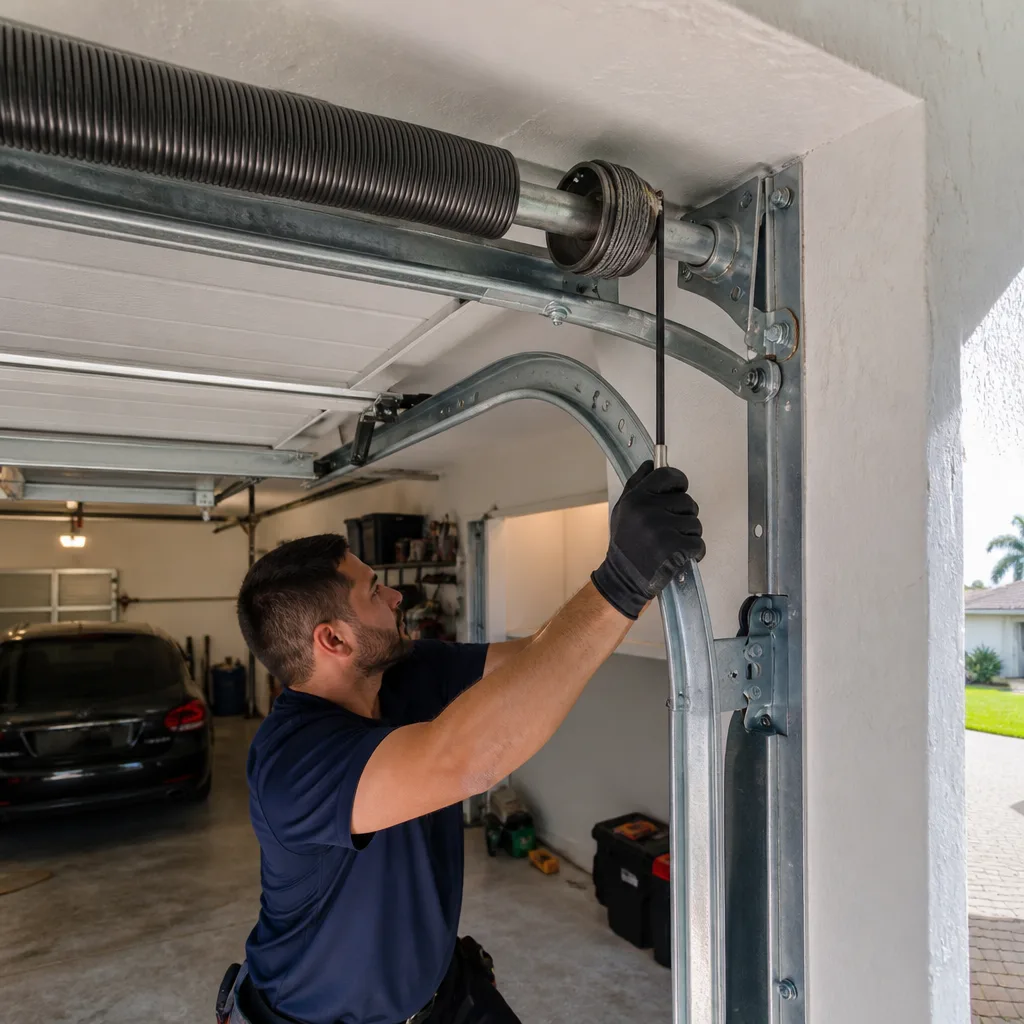
Some of the checks in this guide are things you can do yourself: the balance test, the visual inspection, the photo record, the lubrication. Others are not. Torsion springs under tension should not be adjusted, replaced, or removed by a homeowner, period. The winding and unwinding of a spring is done with specialized bars, and a spring that lets go during service releases enough force to cause serious injury. Cables under tension are the same story. If a cable is fraying at the drum or has jumped the drum, close the door and call someone who does this daily.
If you are in West Palm Beach and something on this checklist tells you a component has reached replacement condition, Servo Garage Doors West Palm Beach offers free estimates in the area. Every job is quoted with a flat, written price and written scope before any work starts, per Clause 1 of The Haven Standard, and every visit closes with a documented photo record of what was found and what was done. Call (561) 489-7509.
Frequently Asked Questions
Run the visual and balance checks every four months, and lubricate hinges, rollers, and springs every three months. In West Palm Beach, this is more frequent than most national guides recommend, because the heat fatigues springs faster and the wet season accelerates corrosion. If you live within a mile of the ocean, lubricate every two months. The four-month interval catches most problems before they become failures.
Torsion spring failure is the most common failure we see, and it happens at a younger age here than in most of the country. The daily heat cycle, with door surfaces reaching 140°F and then dropping after thunderstorms, fatigues the spring steel faster than manufacturer cycle ratings predict. The spring balance test is the best early warning system, and it costs nothing but four minutes.
Spring replacement in West Palm Beach typically ranges from $180 to $340 for a single spring and $300 to $500 for a pair, depending on spring size, wire diameter, and whether the springs are standard or high-cycle. The price will be quoted in writing before any work starts. Call (561) 489-7509 for an exact quote; estimates are free.
Yes, you can and should lubricate hinges, rollers, and torsion springs yourself with a silicone or Teflon spray. The labor is simple: spray the hinge pins, the roller bearings, and the spring coils, then run the door twice to work it in. Avoid white lithium spray on hinges and springs in West Palm Beach, because it gums up in our heat. What you should not do yourself is adjust or replace the torsion spring; that is a professional job because the spring is under extreme tension.
If your door was installed before the Florida Building Code updates in the early 2000s, it likely does not meet current wind-load requirements, even if the house is in a wind-rated zone. The pre-hurricane hardware audit in this guide covers the fasteners, struts, and brackets that determine whether a wind-rated door actually performs as rated. If the audit turns up loose or corroded fasteners, address them before hurricane season begins. Servo Garage Doors West Palm Beach can inspect the door and provide a written assessment; call (561) 489-7509 to schedule.
Do not attempt to open the door manually and do not use the opener. A loud bang followed by a door that will not move is usually a snapped torsion spring. With the spring broken, there is no counterbalance, and the door can drop. A snapped spring replacement is a same-day repair for most doors and most brands, including Raynor, LiftMaster, Chamberlain, and Genie. Call (561) 489-7509; our phones are answered by a real person 24 hours a day.
The Bottom Line
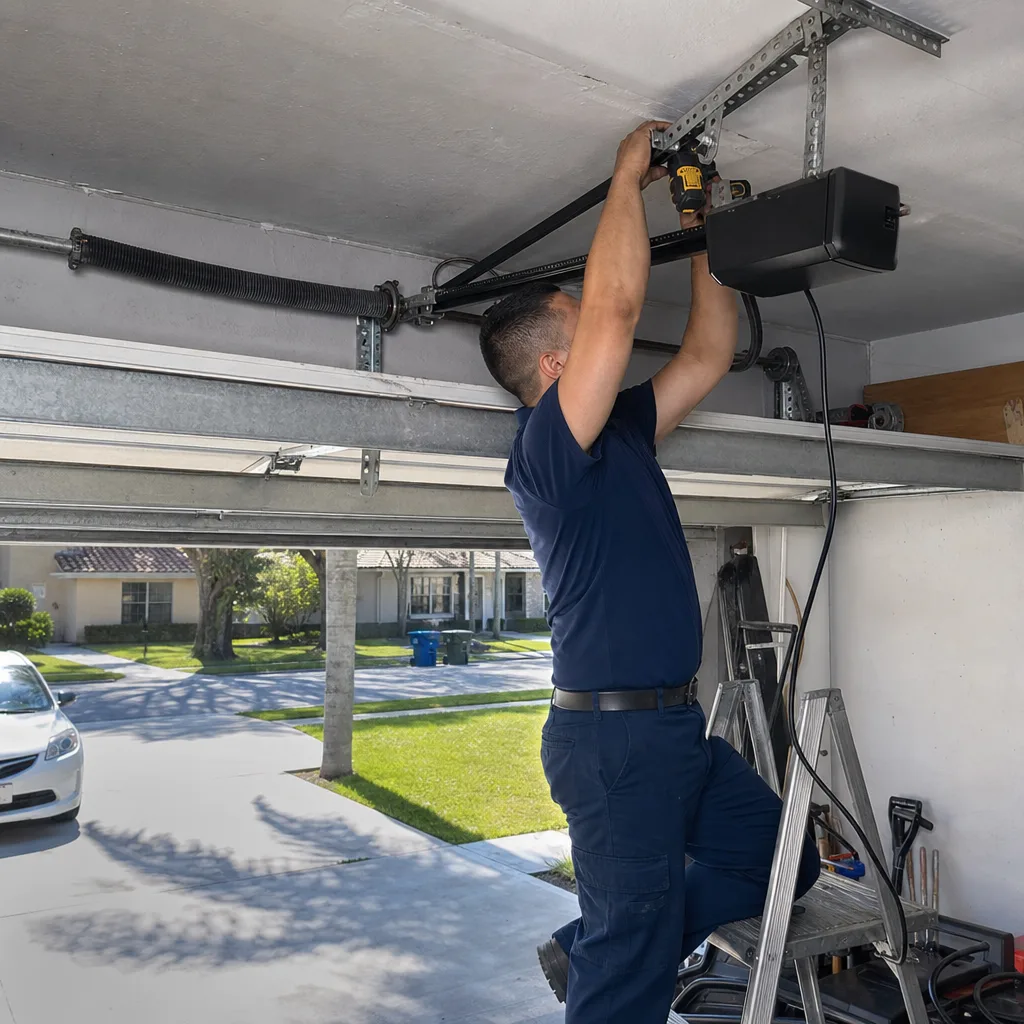
The garage door maintenance schedule that works in West Palm Beach is built around conditions, not calendars. Test spring balance every four months. Inspect bottom brackets, hinges, and track hardware after wet season ends. Audit fasteners and struts before hurricane season begins. Lubricate with silicone or Teflon every three months, not white lithium. Photograph everything, because a photo record is the only reliable baseline for future decisions. And if any check reveals a part that has reached replacement condition, call garage door installation or replacement professionals in West Palm Beach for a written price before work starts. The door will tell you what it needs. These checks teach you how to listen.
Written by Marcus Deller, Owner at Servo Garage Doors West Palm Beach, serving West Palm Beach since 2015. Explore more guides & resources on our blog.
For more on how we work, see the Servo Garage Doors West Palm Beach home page, or contact us at (561) 489-7509 for a free estimate.