
Last updated September 20, 2026
Full 25-point door and opener safety check with every visit - springs, cables, rollers, tracks, and your LiftMaster or Chamberlain opener included
You get a price before we start. It does not change when the truck arrives.
 Before
 After
After Before
 After
After Before
 After
AfterSeasonal Garage Door Care for West Palm Beach: Year-Round Homeowner’s Guide
The Atlantic hurricane season officially begins June 1, but the first named storm capable of producing West Palm Beach wind events typically arrives by mid-August. That leaves a narrow window, roughly May through early July, when a homeowner can actually address what the dry season did to their garage hardware before wind loads become the deciding factor. This guide covers the two-season maintenance rhythm that matches how South Florida weather actually damages garage doors: the May pre-storm audit and the November-April dry season adjustments, plus the post-storm inspection protocol every homeowner in Palm Beach County should know. For a deeper dive, see The Complete Guide to Garage Door in West Palm Beach.
Quick Answer
Seasonal garage door care in West Palm Beach should follow a two-season calendar, not a four-season one. Complete a full hardware audit and hurricane-prep check every May before the Atlantic season intensifies, then perform a dry-season adjustment pass each November through April to correct metal contraction and seal hardening caused by cooler, lower-humidity air. Homeowners within three miles of the Intracoastal should lubricate and inspect hardware twice as often as inland homeowners due to salt air accumulation.
Table of Contents
- The May Audit: What to Check Before Hurricane Season
- Dry Season Metal Contraction: Why Your Door Gets Louder in January
- Salt Air and Your Lubrication Schedule: Distance From the Intracoastal Changes Everything
- UV Degradation of Weatherstripping: The Seal That Stops Protecting You
- Post-Storm Inspection Protocol: The 45 mph Threshold
- A Working Seasonal Maintenance Calendar for West Palm Beach
- Common Mistakes to Avoid
- When to Call a Professional
- Frequently Asked Questions
- The Bottom Line
BeforeAfterThe May Audit: What to Check Before Hurricane Season
If you do one garage door inspection per year, do it in May. Not January, not September. May is when the dry season has finished stressing your hardware and the hurricane season has not yet started loading it. You get a clear picture of wear without the time pressure of an approaching storm.
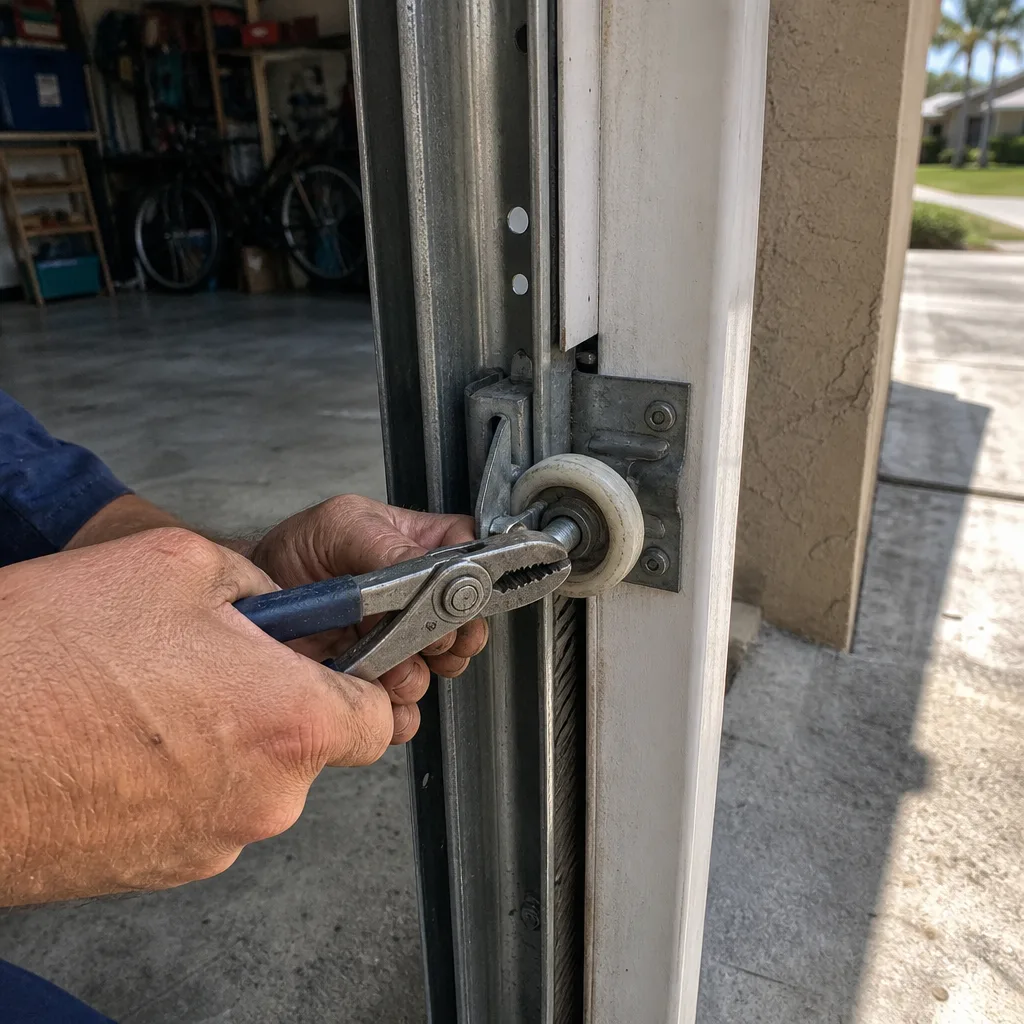
Here is the full May audit in the order we perform it when we work on garage doors across West Palm Beach, from El Cid to the north end of Palm Beach Lakes:
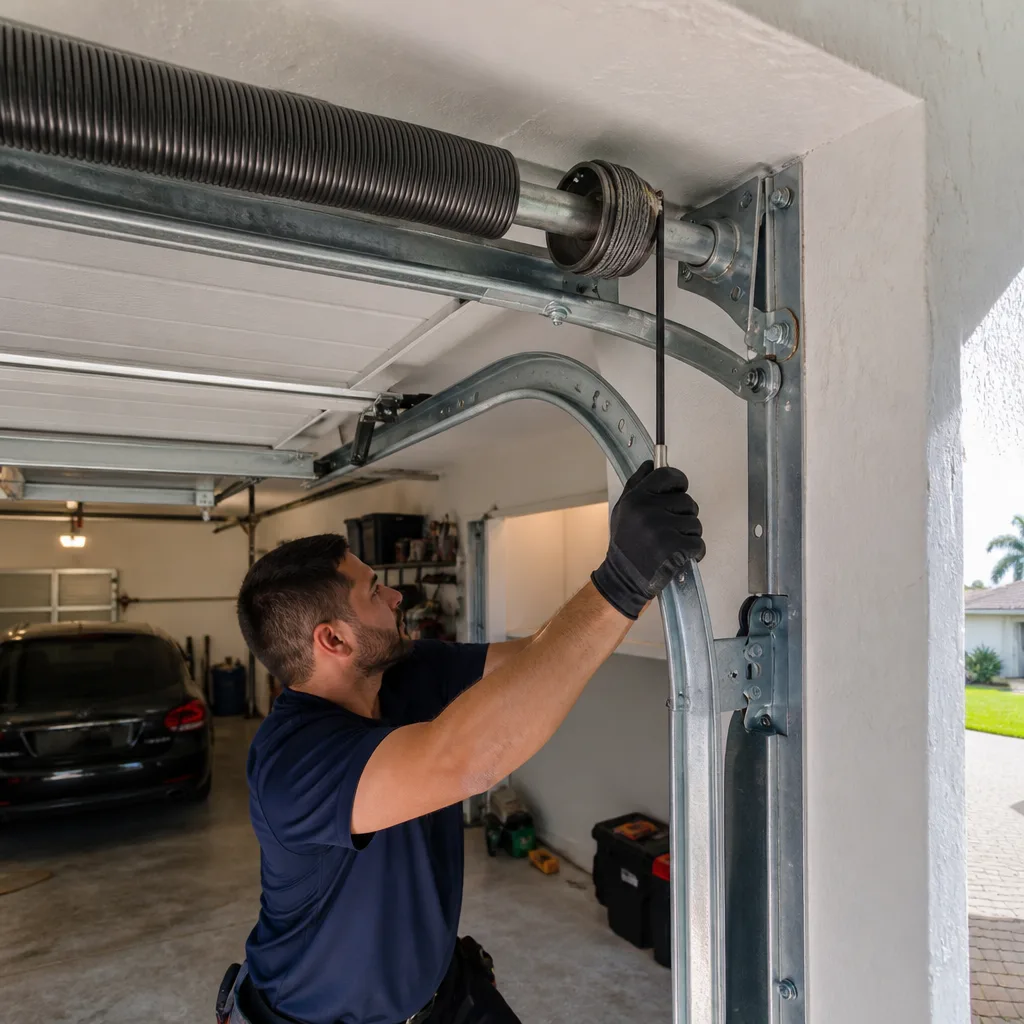
- Torque check on all hinge bolts, track brackets, and the operator rail. The dry season’s lower humidity causes metal to contract, and fasteners that were tight in October are frequently loose by April. A 7/16-inch socket covers most residential hinge bolts; track brackets often take 1/2-inch. You are not looking for dramatic movement, just any fastener that turns under moderate hand pressure. If it turns, it was loose enough to matter.
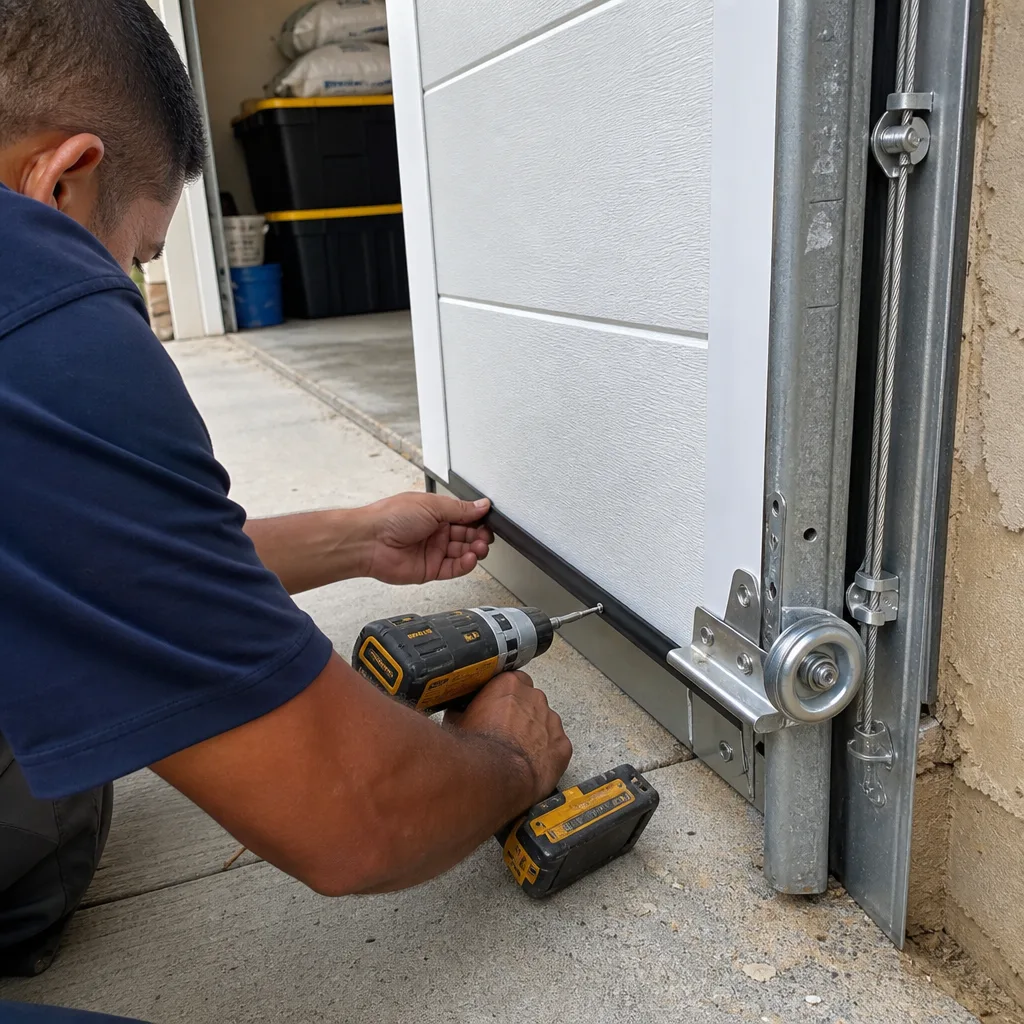
- Bottom seal condition assessment. Run your hand along the bottom seal, also called the astragal, with the door closed. It should compress slightly under finger pressure and spring back. If it feels stiff, cracked, or has visible daylight gaps at the corners, it is no longer sealing. In West Palm Beach, a failed bottom seal is a water-intrusion pathway during any storm that drives rain horizontally, which most of them do.
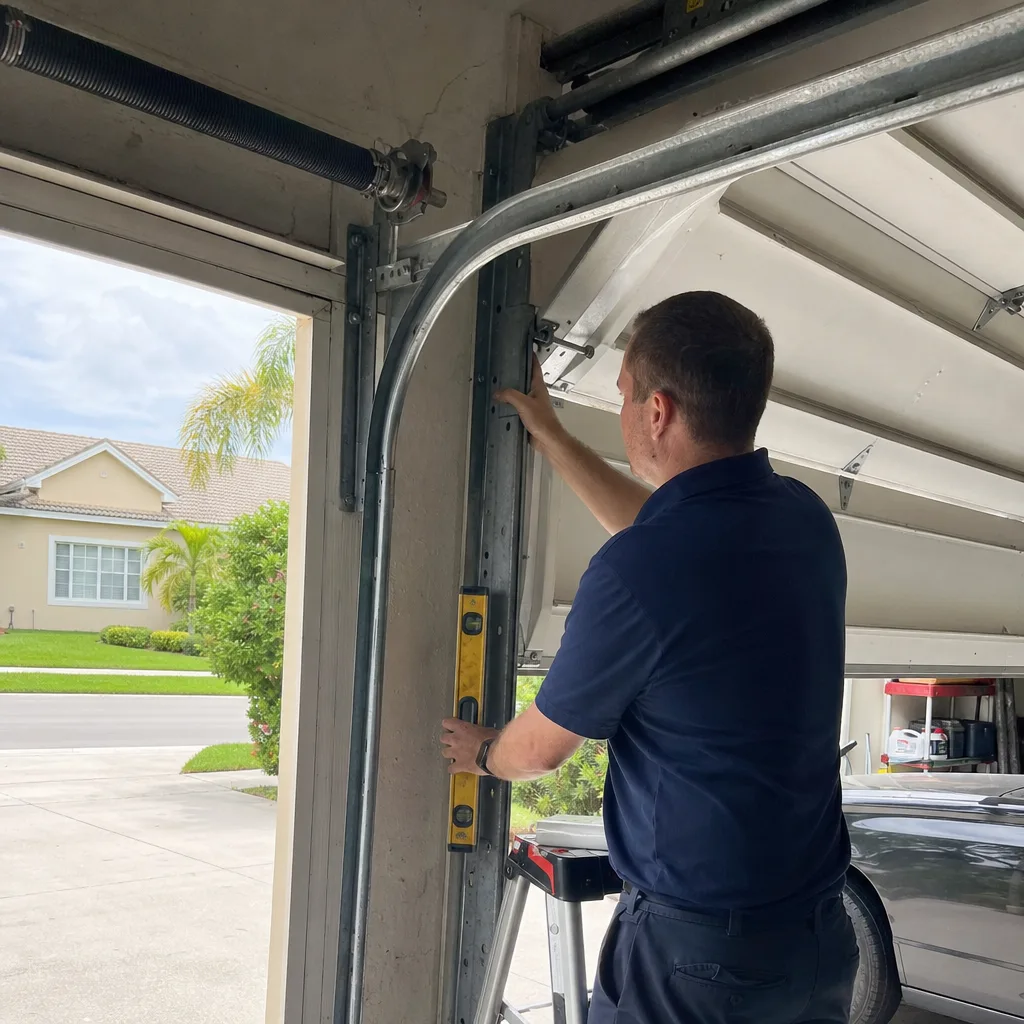
- Track alignment measurement. With the door closed, measure the distance between the vertical track and the door edge at three points: top, middle, and bottom, on both sides. All six measurements should be within 1/8 inch of each other. A larger variance means track brackets have shifted, and a shifted track under wind load is how doors come off their rails during storms.
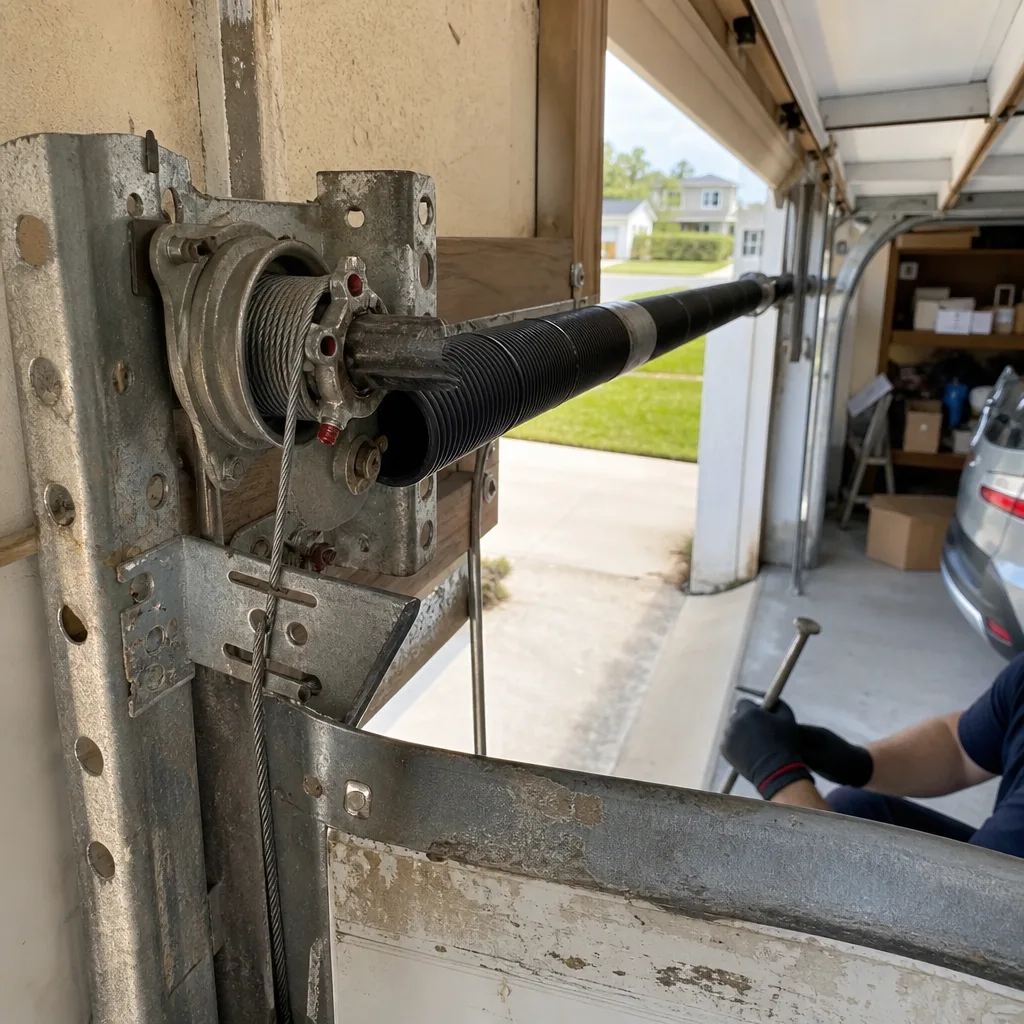
- Balance test. Release the door from the opener using the red emergency cord, then lift it manually to waist height. It should stay in place without assistance. A door that drops or rises on its own has a spring tension issue. In South Florida, torsion springs degrade faster than in drier climates due to humidity-driven surface corrosion, especially within three miles of salt water.
- Lubrication pass. White lithium grease on the torsion spring coils, hinge pins, and bearing plates. A silicone-based lubricant on the track channels, applied lightly. Do not use WD-40 as a primary lubricant; it displaces water but does not leave a lasting film.
- Opener force setting verification. Most openers installed after 2015 have an adjustable force setting. It should be set high enough to move the door consistently through its full travel, but low enough that the door reverses when it encounters resistance. After a dry season, hinges tighten and rollers lose some glide, so the opener may be fighting more friction than it was in October.
A door that passes all six checks is in good condition for whatever the Atlantic decides to do. A door that fails any of them has a known issue, and known issues are fixable before a named storm reaches South Florida.
Dry Season Metal Contraction: Why Your Door Gets Louder in January
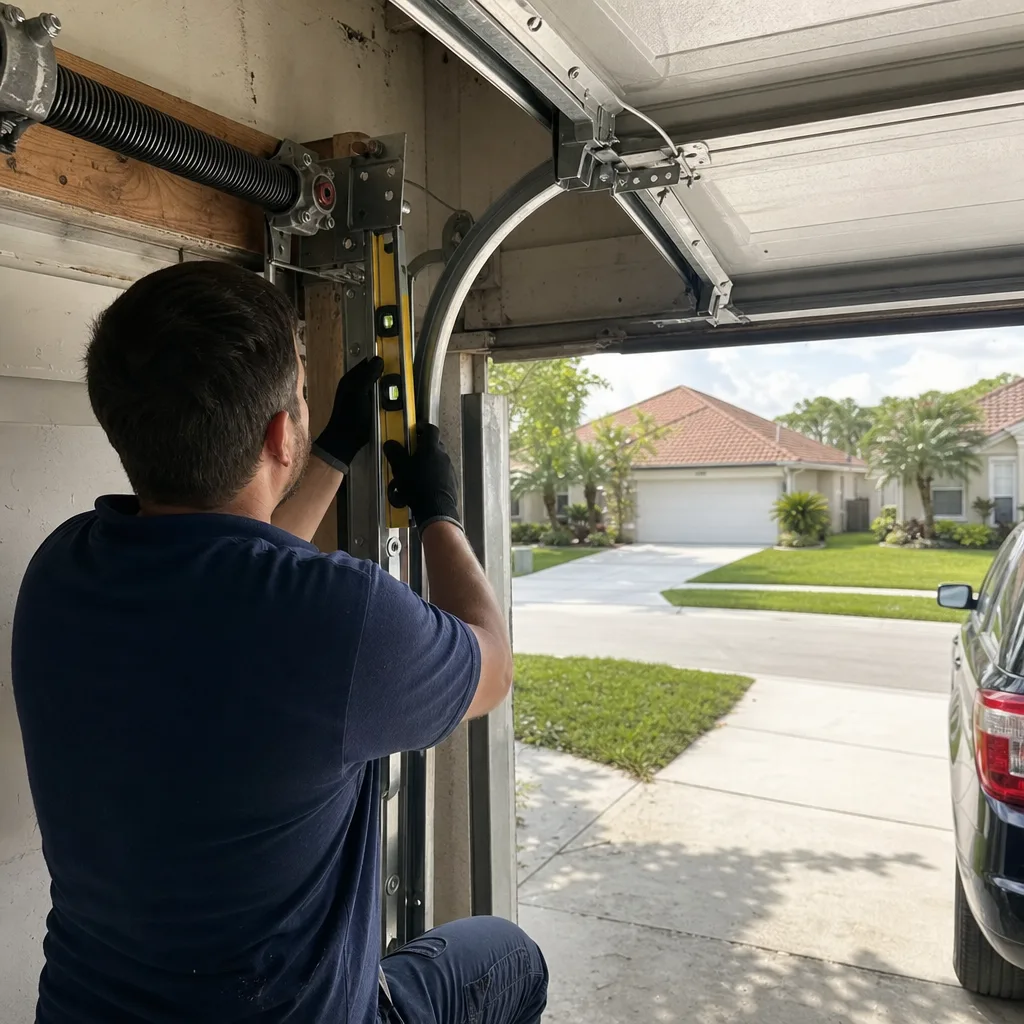
West Palm Beach’s dry season, roughly November through April, brings two changes that affect garage door hardware: lower humidity and cooler overnight temperatures. Both cause metal to contract. The effect is measurable. A 16-foot steel door will contract by a small but meaningful fraction in January compared to August, and that contraction gets concentrated at every hinge point, bracket, and roller stem.
The most common symptom we see in West Palm Beach during December and January is a door that suddenly grinds, binds, or squeaks when it ran quietly in September. The homeowner’s instinct is often to call a repair service, but in many cases the issue is simply that metal components that were correctly adjusted in humid, 90-degree weather have shifted by a few thousandths of an inch. That is enough to turn a smooth-rolling door into one that complains.
Here is what happens specifically:
- Steel tracks contract and narrow slightly. Rollers that had proper clearance in August now rub against the inside of the track channel. The sound is a metal-on-metal grind, most noticeable in the first three to four feet of travel.
- Hinge pins tighten. The pins that connect door panels at each hinge point are steel, and steel shrinks in cooler air. The hinge barrels become slightly tighter, which increases rolling resistance.
- The torsion spring loses a small amount of lift capacity. Torsion springs are rated for a specific number of cycles, but their effective torque output varies slightly with temperature. In January, a spring near the end of its service life may fail to keep a door balanced that it held open fine in September.
The fix is not dramatic. A dry-season adjustment pass means loosening track brackets slightly, confirming rollers have their proper clearance, and re-lubricating anything that moves. If the noise persists after that, the rollers themselves may be worn. Nylon rollers have a service life of roughly 7 to 10 years in South Florida humidity, and steel ball bearings inside them corrode even faster within three miles of the coast.
If you are not comfortable loosening track brackets, this is a straightforward service call. Any competent garage door technician in West Palm Beach can perform a dry-season adjustment in under an hour, and the result should be a door that runs quiet again.
Salt Air and Your Lubrication Schedule: Distance From the Intracoastal Changes Everything
West Palm Beach is not one climate zone. A home in Palm Beach Gardens, three blocks from the Intracoastal Waterway, is exposed to a meaningfully different environment than a home in Wellington, 15 miles inland. The difference is airborne salt, and it changes how often garage door hardware needs attention.
Salt air is a corrosion accelerant. It deposits on metal surfaces, attracts moisture even during low-humidity periods, and creates a conductive film that speeds up oxidation. For garage door hardware, that means:
- Torsion springs develop surface rust faster, which reduces their cycle life. A spring rated for 10,000 cycles in a dry inland environment may give 7,500 cycles within three miles of salt water.
- Roller bearings, especially steel-bearing rollers on doors installed before 2015, seize sooner. Nylon rollers with sealed bearings resist this better.
- Hinge pins and track brackets accumulate a gritty salt film that acts as an abrasive when combined with the standard dust that blows through South Florida.
The practical difference in maintenance schedule:
- Within three miles of the Intracoastal or the Atlantic: Lubricate hinges, springs, and bearing plates every three to four months. Inspect for rust on hardware every two months. If a spring shows visible rust pitting, have it evaluated; rust pitting is how torsion springs snap under load.
- Three to ten miles inland, which covers most of central and western West Palm Beach, Westgate, and the neighborhoods around Southern Boulevard: Lubricate every six months, usually as part of the May audit and again in November.
- Fifteen miles or more inland, which includes Wellington and Royal Palm Beach: Lubricate annually, typically in May. Salt exposure is minimal, and the primary concerns shift to dust accumulation and UV degradation.
If you live east of I-95, assume the salt-air schedule applies to you. It is the single highest-impact adjustment a coastal West Palm Beach homeowner can make to extend hardware life.
UV Degradation of Weatherstripping: The Seal That Stops Protecting You
South Florida sun is hard on rubber and vinyl. Garage door weatherstripping, especially the bottom seal and the vertical seals along the jambs, has a typical service life of three to five years in West Palm Beach. That is shorter than what manufacturers publish, because their ratings assume a temperate climate with moderate UV exposure, not 240-plus days of direct subtropical sun per year.
The failure mode is not just cracking. It is hardening. UV radiation breaks down the plasticizers in vinyl and rubber compounds, which causes the material to lose elasticity. A seal that has hardened can no longer compress against the floor or the door edge, even if it looks mostly intact from a distance.
Here is how to tell if your weatherstripping has crossed the line from cosmetic wear to functional failure:
- The press test: Close the garage door, then press the bottom seal with your thumb. A healthy seal compresses and rebounds within a second. A hardened seal feels rigid, like pressing on a plastic cutting board, and does not rebound.
- The daylight test: With the garage door closed and the interior lights off, look along the bottom edge and sides from inside the garage. Any visible light means a gap, and a gap means water, dust, and insects have a path in.
- The chalk-line test: Lay a line of sidewalk chalk on the garage floor directly under the bottom seal, close the door, open it, and check the chalk. A proper seal smears the chalk evenly across its full width. Gaps in the chalk pattern show where the seal is not making contact.
A failed bottom seal is a water-intrusion pathway during any West Palm Beach afternoon thunderstorm, not just during hurricanes. Replacing it is a $60 to $120 part depending on door width and material, and it is the single most cost-effective seasonal maintenance item on the door. For a full picture of what garage door work costs locally, see our Garage Door Cost Breakdown: The West Palm Beach Homeowner’s Reference for 2026.
Brands like Clopay and Amarr manufacture replacement weatherstripping sized to their specific door models. If your door is one of those, use the manufacturer-matched seal rather than a universal replacement; universal seals often fit imperfectly, and an imperfect seal is only marginally better than a failed one.
Post-Storm Inspection Protocol: The 45 mph Threshold
In Palm Beach County, sustained winds above 45 mph are the point at which garage door hardware displacement becomes statistically common. That threshold is not a guess; it is the wind speed at which the measured pressure differential across a standard two-car garage door begins to flex the door panels and load the track brackets beyond their normal working range.
After any storm that brings sustained winds above 45 mph to West Palm Beach, inspect the following, in this order:
- Check the header and track brackets for movement. Look for fresh gaps between the bracket and the wall, cracked drywall around the bracket, or visible bending. A bracket that shifted during a storm may still hold the track in place, but it has lost structural margin.
- Cycle the door manually. Release the opener with the red emergency cord and run the door through its full travel by hand. It should move smoothly with consistent resistance. Any binding, hesitation, or popping sound means something changed during the storm.
- Check panel seams for separation. Wind pressure can flex panels enough to loosen hinge screws or pull the strut, the horizontal brace on the inside of the top panel, away from the door. Look at the top panel first; it takes the most wind load when the door bows inward.
- Inspect the bottom seal for displacement. A strong enough pressure differential can pull the bottom seal partially out of its retainer track. If the seal is displaced, fix it before the next rain.
- Test the opener’s auto-reverse. Place a 2×4 flat on the floor under the door’s travel path and close the door. It should reverse upon contact. If the storm caused any track misalignment, the auto-reverse may not engage properly, and that is a safety issue, not just a performance issue.
If any of these checks reveal a problem, address it before the next storm. A door with displaced hardware is more vulnerable to the next wind event, and failures compound.
A Working Seasonal Maintenance Calendar for West Palm Beach
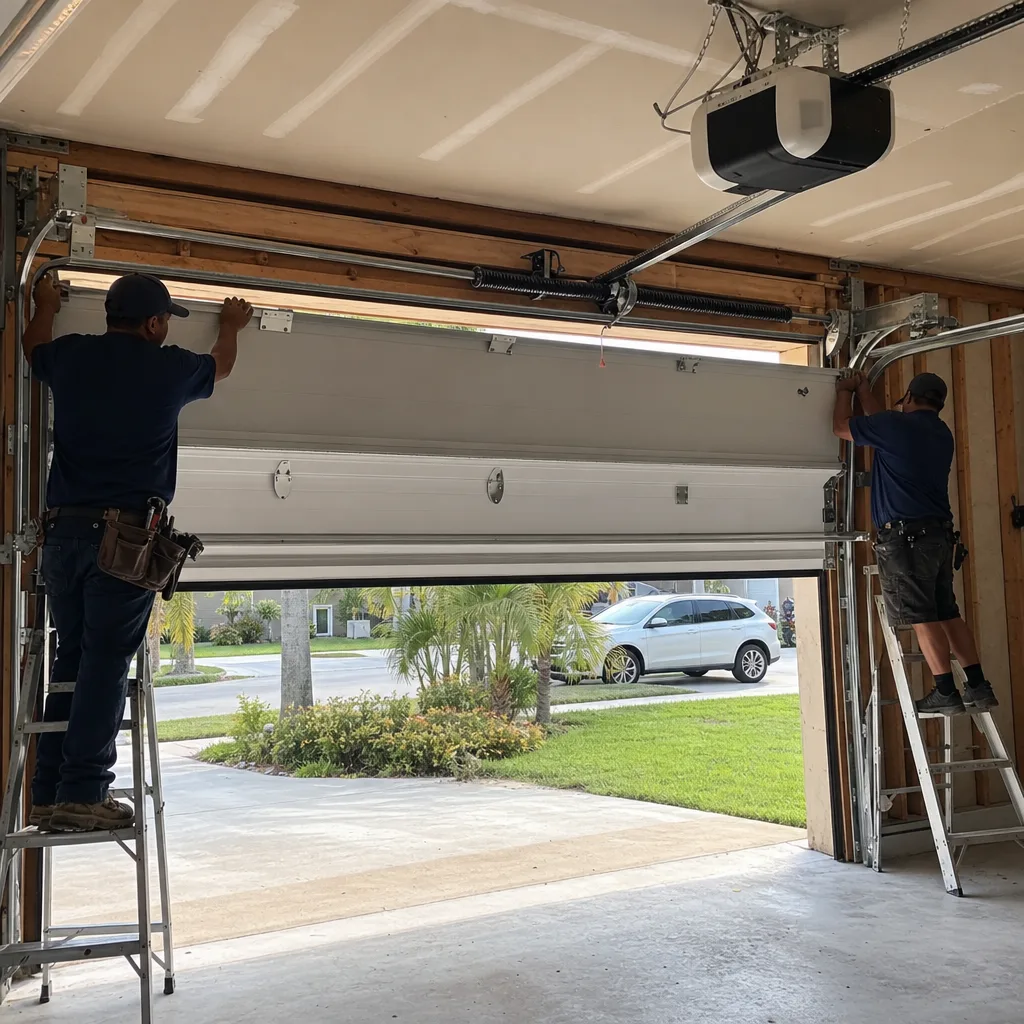
The traditional four-season maintenance calendar does not map to South Florida. Here is the two-season calendar we recommend for West Palm Beach homeowners, based on how our weather actually affects garage hardware:
May: The Pre-Hurricane Audit
- Complete the full six-point May audit described above.
- Replace any bottom seal that fails the press test or shows daylight gaps.
- Apply white lithium grease to torsion springs, hinge pins, and bearing plates.
- Confirm the opener’s force setting and auto-reverse function.
- If your door is within three miles of the Intracoastal, perform a visual rust inspection on all springs and cables.
- Photograph the door, springs, tracks, and seals. This becomes your baseline for post-storm comparison.
November: The Dry-Season Adjustment
- Loosen and re-torque all hinge bolts, track brackets, and operator rail fasteners to correct dry-season contraction.
- Re-lubricate if you are within three miles of salt water. Inland homeowners can defer lubrication to the May audit.
- Check the door balance manually; a door that was balanced in May may not be balanced in December due to temperature-related spring behavior.
- Test the opener’s force setting. Dry-season friction changes may require a slight increase in force to move the door reliably.
- Inspect weatherstripping for UV hardening even in cooler months. West Palm Beach UV exposure is year-round.
Post-Storm (Any Month, Winds Above 45 mph)
- Run the five-point post-storm inspection described above.
- Compare current photos against your May baseline.
- If anything moved, schedule the repair before the next rain event.
The entire calendar takes about 90 minutes per year for a homeowner who is comfortable doing basic checks, plus whatever repairs the inspections surface. For homeowners who are not comfortable working around a door under spring tension, the inspection itself is a straightforward service call.
Common Mistakes to Avoid
- Skipping the May audit because the door “works fine.” A garage door that works fine in calm weather can fail in 70 mph gusts if a track bracket has shifted or a spring has lost tension. The May audit exists to find problems before wind finds them.
- Using WD-40 on torsion springs as a permanent lubricant. WD-40 is a water displacer and short-term penetrant. It does not leave a lasting lubricating film, and on torsion springs it can actually wash away the grease that is there. Use white lithium grease or a dedicated garage door lubricant.
- Ignoring a noisy door in January and assuming it will fix itself. A door that grinds during the dry season is telling you something about clearance, lubrication, or roller condition. The noise does not resolve when humidity returns; it just changes character.
- Replacing only the bottom seal when the vertical jamb seals are also hardened. Water intrusion in West Palm Beach comes horizontally as often as vertically. The side seals matter as much as the bottom seal, and a door is only as water-resistant as its weakest seal.
- Attempting to adjust or replace a torsion spring without the right tools and training. Torsion springs are under high tension, and a spring that releases unexpectedly can cause serious injury. This is the one component on a garage door that should never be a DIY project.
- Waiting until a storm is in the forecast to schedule service. Once a named storm is approaching South Florida, every reputable garage door company in West Palm Beach is booked. The May audit window exists because it is the last time a homeowner has realistic lead time.
- Lubricating the track channels themselves. Rollers are designed to roll on a clean track, not slide through grease. Lubricating the track attracts dust and grit, which accelerates roller wear. Lubricate the rollers, hinges, and springs; leave the tracks clean.
When to Call a Professional
Some seasonal maintenance is homeowner territory: the press test on the bottom seal, the daylight test, the chalk-line test, a visual check for rust and loose brackets. But certain conditions call for a trained technician, and waiting on them costs more than the call would have.
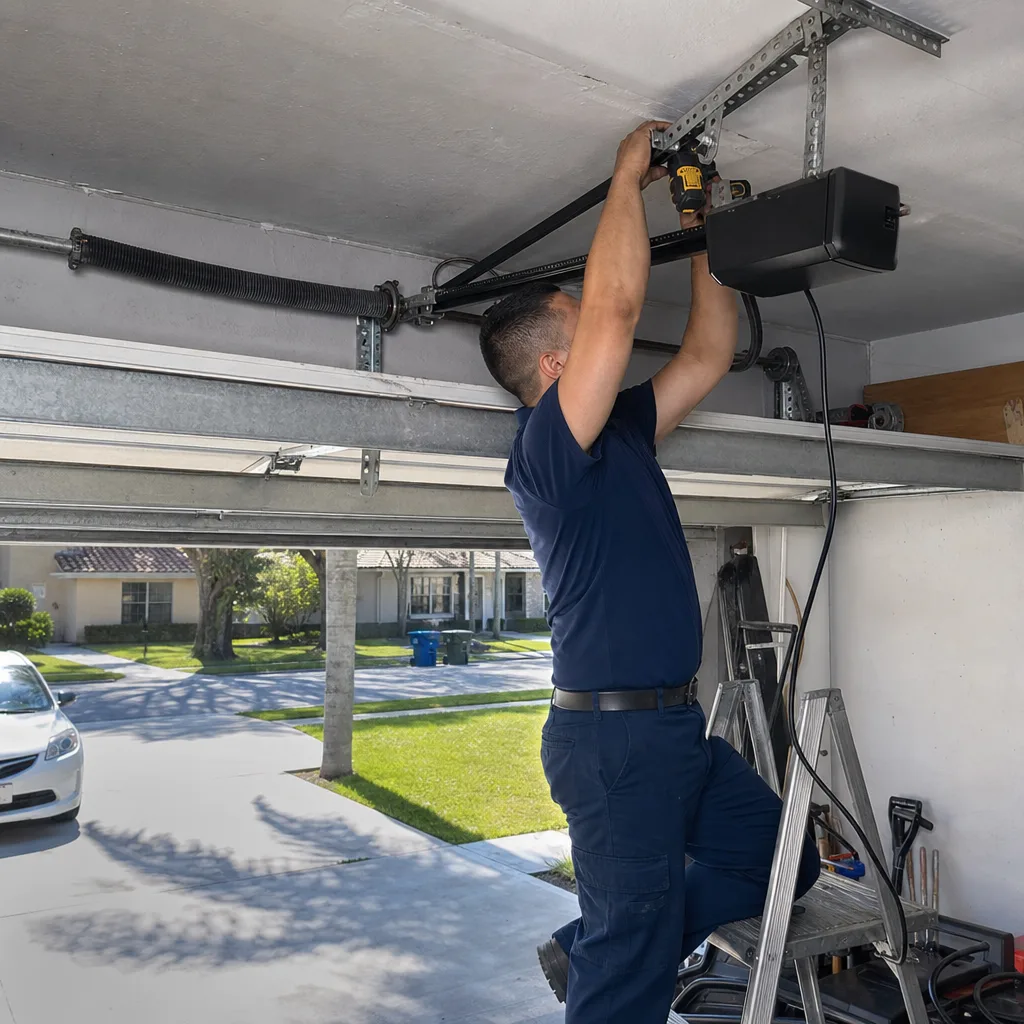
Call a professional if: the door fails the balance test and drops or rises on its own; you see visible rust pitting on a torsion spring; the door came off its track during a storm; the opener’s auto-reverse does not engage; any track bracket shows cracking or movement at the wall; or you hear a grinding sound that persists after lubrication. These are not adjustment issues. They are repair issues.
Servo Garage Doors West Palm Beach offers free estimates in West Palm Beach, and every job is quoted with a flat, written price before any work begins. That is Clause 1 of The Haven Standard, and it means you know the number before we touch the door. Call (561) 489-7509.
Frequently Asked Questions
A seasonal garage door tune-up in West Palm Beach typically runs between $90 and $180, depending on the door size, hardware condition, and whether lubrication and minor adjustments are included. Servo does not price tune-ups over the phone; every job receives a flat, written price before any work starts, which is Clause 1 of The Haven Standard. Call (561) 489-7509 for an exact quote.
Under the Florida Building Code, garage doors in the High Velocity Hurricane Zone, which includes West Palm Beach and all of Palm Beach County, must be rated for wind loads specific to the structure’s location. A May audit that finds loose brackets, a failed balance test, or a rusted spring is identifying the door’s inability to perform at its rated wind load, whether or not additional bracing was originally installed.
If you are within three miles of the Intracoastal or the Atlantic, lubricate every three to four months. If you are three to fifteen miles inland, every six months is adequate. If you are in Wellington or Royal Palm Beach, annually in May is sufficient. Salt air is the variable that changes the schedule.
During the pre-storm rush, same-day service cannot be guaranteed. That is why the May audit exists. Outside of storm events, Servo Garage Doors West Palm Beach typically can schedule most repairs within one to two business days. Emergency calls are answered by a live person 24/7 at (561) 489-7509.
No. The flat, written price quoted before work starts is the price. If the technician finds something during the visit that was not in the original scope, you will receive a written change order with a new price before any additional work begins. This is Clause 1 of The Haven Standard, and it applies to every job Servo performs in West Palm Beach.
Yes. Servo Garage Doors West Palm Beach services and installs all eight major brands, including LiftMaster, Chamberlain, Genie, Clopay, Amarr, Wayne Dalton, Craftsman, and Raynor. The brand of your door does not change the documentation standard or the written-price-first policy.
The Bottom Line
West Palm Beach does not have four seasons, and trying to maintain a garage door on a four-season schedule means missing your window. The May audit before hurricane season is the check that matters most; the dry-season adjustment pass between November and April is the one that keeps a door running quietly and safely. Salt air near the Intracoastal demands a lubrication schedule that Wellington homeowners can ignore. UV hardening of weatherstripping is a functional failure, not a cosmetic one, and it is visible with a simple press test. Do the checks, fix what you find, and when something is beyond your comfort level, get a written price before anyone touches the door. For more guides & resources on keeping your garage door reliable through South Florida’s unique climate, explore our blog.
Written by Marcus Deller, Owner at Servo Garage Doors West Palm Beach, serving West Palm Beach since 2015.